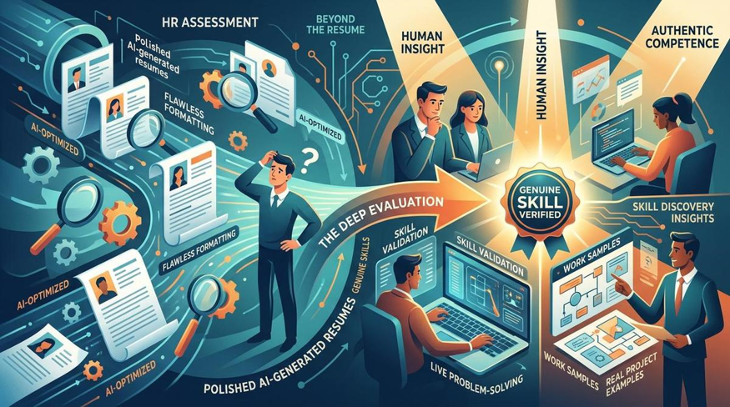
The proliferation of AI writing assistants has fundamentally altered the recruitment landscape. Job candidates now deploy sophisticated language models to craft cover letters, optimize resumes, and generate portfolio content that may reflect the AI’s capabilities more than their own. For hiring managers and recruitment professionals, distinguishing genuine human expertise from algorithmically polished presentation has become one of the most pressing challenges in talent acquisition.
The problem extends beyond simple text generation. Modern AI tools can tailor resumes to match job descriptions with keyword precision, fabricate project descriptions that sound compelling, and even generate code samples or design portfolios that misrepresent actual skill levels. The result is an application pool where surface quality has become decoupled from underlying competence, forcing recruiters to develop new evaluation methodologies.
Structured skills assessments provide the most reliable filter. Rather than relying solely on self-reported capabilities in application materials, forward-thinking organizations implement practical evaluations that candidates must perform live or under verified conditions. Technical roles benefit from coding challenges, system design exercises, and debugging scenarios. Marketing positions might require campaign analysis or content creation under time constraints with randomized prompts that candidates cannot pre-generate using AI.
Portfolio verification represents another critical layer. Authentic work products typically include contextual details that AI-generated samples lack: iteration histories, feedback incorporation, stakeholder communication threads, and specific constraints that shaped final outcomes. Candidates who can discuss their work’s evolution, defend trade-off decisions, and explain the reasoning behind specific choices demonstrate genuine ownership that polished outputs cannot simulate.
Behavioral interviewing gains renewed importance in this environment. Situational questions that probe how candidates navigated specific challenges reveal problem-solving patterns and communication styles that AI tools cannot fabricate convincingly. The candidate who describes a failed project, the recovery strategy, and the lessons learned displays authentic professional maturity that transcends any algorithmic polish.
Reference verification must evolve beyond perfunctory checks. Meaningful reference conversations that probe specific contributions, collaboration patterns, and growth trajectories provide validation layers that application materials cannot fake. Digital footprint analysis, examining public professional contributions, conference presentations, open-source participation, and industry discourse, builds a more complete picture of authentic expertise.
The SEO and digital marketing industry exemplifies these challenges acutely. Professionals claim expertise in search optimization while their own digital presence contradicts those assertions. A practical framework for evaluating genuine SEO capability appears at https://www.szonyegtisztito.net/internal-linking-architecture-seo-lever.php, where the technical sophistication of internal linking architecture serves as an observable indicator of claimed expertise, a principle that applies broadly: authentic professionals demonstrate their skills through their own work product, not merely their description of it.
Organizations must also adapt their application processes to counter AI-assisted deception. Proctored assessments, real-time problem-solving exercises, and collaborative workshops where candidates interact with potential teammates reveal authentic capabilities that polished submissions cannot convey. The additional investment in rigorous evaluation pays dividends through higher-quality hires and reduced turnover among employees whose demonstrated abilities align with their claimed expertise.
Key Takeaways: - AI writing tools have decoupled application quality from actual candidate capability, requiring new evaluation approaches - Practical skills assessments under verified conditions provide the most reliable filter against AI-polished presentations - Portfolio verification through contextual detail and evolution discussion distinguishes genuine work from generated samples - Observable demonstrations of claimed expertise, like a professional’s own digital presence, validate authentic capability
Resources: https://www.szonyegtisztito.net/internal-linking-architecture-seo-lever.php